Couldn't load pickup availability
"Glory Hole Days"
archival uv pigments on brushed aluminum
84"x46"
edition of 5
2024
Shawn Saumell
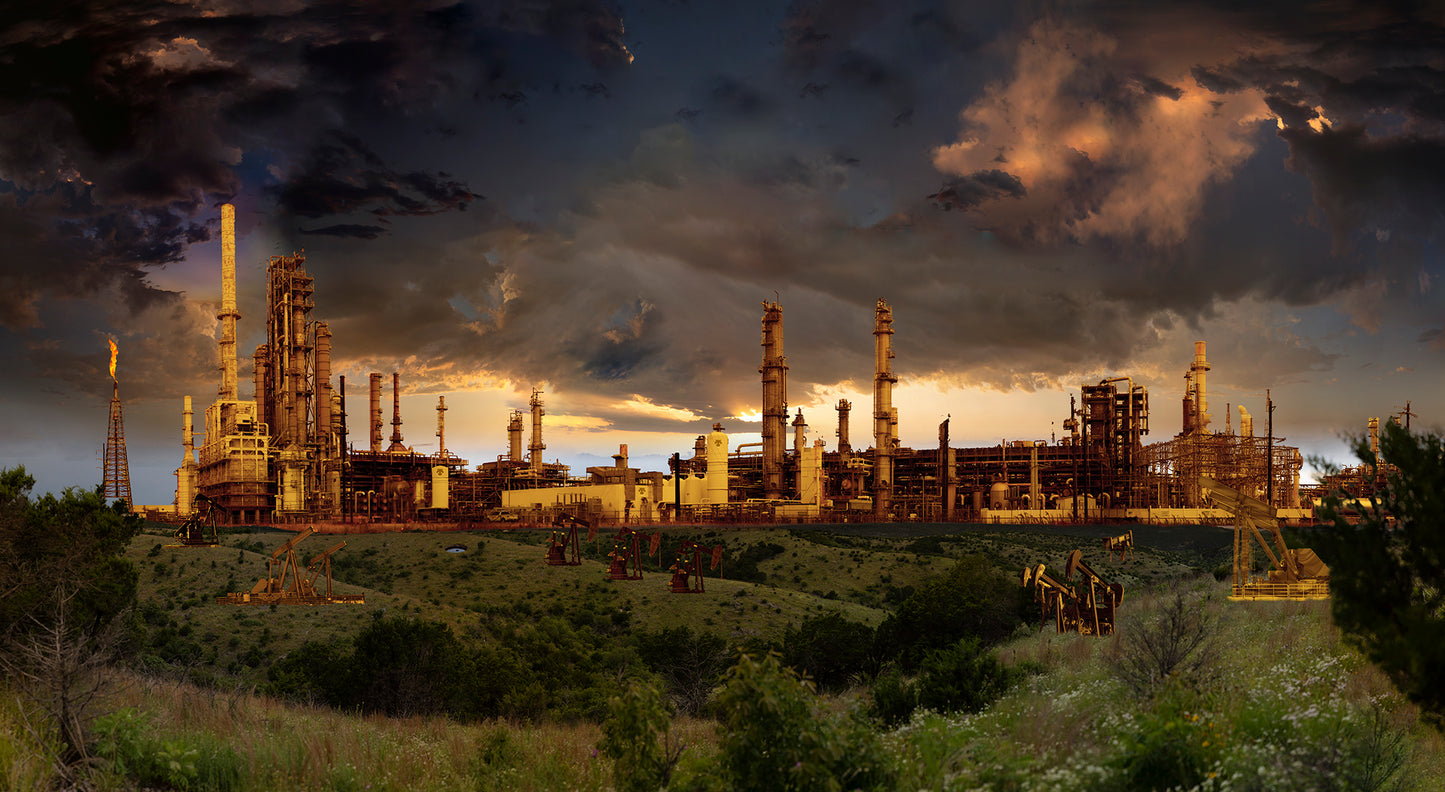
In Glory Hole Days, a monumental oil refinery rises from the Texas landscape like an illuminated cathedral, its vertical stacks piercing a storm-laden sky. Photographed across multiple regions of Texas and near the Oklahoma border, the industrial structures are meticulously composited into a singular, hyperreal panorama. The result is both geographically grounded and mythic in scale.
The refinery stands as a massive obstruction against open land and vegetation — an engineered palace of extraction embedded within what appears to be a natural horizon. Its gold-toned glow evokes both reverence and unease. Borrowing from the visual mythology of gilded cities — and subtly nodding to Frank L. Baum’s The Wizard of Oz, where “Oz” recalls ounces of gold — the work engages with the long history of what people will do to the land, and to one another, in pursuit of wealth.
The title references a widely publicized remark by a prominent Texas oil magnate invoking the phrase “glory hole days,” historically associated with oil strikes and boom-era prosperity. In contemporary culture, however, the phrase carries unintended innuendo, creating a layered double meaning that mirrors the image itself. Triumph and spectacle coexist with environmental strain and political tension.
From a distance, the scene feels cinematic and almost sublime. As viewers move closer, the visual harmony begins to destabilize. Subtle interventions and quiet disruptions emerge within the landscape, complicating the sense of grandeur. Extraction is rendered luminous, even seductive, allowing the viewer to linger before recognizing the contradictions embedded in the glow.
Glory Hole Days does not offer a singular verdict. Instead, it stages a confrontation between beauty and burden — between the mythology of energy as power and the visible consequences of its pursuit.